In short
An Airalo or Holafly eSIM rides a Japanese network: Docomo, au (KDDI), SoftBank, sometimes Rakuten. Pick the network for the trip, then a plan that prints that name, not just a Japan flag. Prices and the operator column sit on the Japan comparison.
- JR, onsen, Hokkaido, off the corridor. Docomo. Compare PlanJapon and packs that write Docomo.
- Tokyo, Osaka, Kyoto only. au (KDDI) or SoftBank will do. Airalo, BambooSIM, eSIM Card on the same page.
- Japan, then Asia. A Japan Docomo pack plus a local one, or an Asia eSIM. Check which Japanese partner the regional uses.
- Rakuten. Almost never the radio behind a tourist eSIM. Skip it unless the listing says so.
The QR code does not radiate in Tokyo. NTT Docomo, au (KDDI), SoftBank and Rakuten Mobile do. A travel eSIM is wholesale capacity glued onto one of those four. Between Shinjuku and a Hakone onsen, the local mast decides if Maps, Suica and translation hold. Not the Airalo logo.
This ranks networks for a visitor, not a Japanese subscriber. Showcase 5G SA speeds weigh less than a coverage hole off the Tokaido. Figures come from Opensignal’s April 2026 report (1 January to 31 March). eSIM partners move: open the operator column on the Japan comparison before you pay.
What “best network” means here
Opensignal does not hand out one overall winner. In spring 2026, au (KDDI) takes the most awards for day-to-day use: video, games, voice, consistency, reliability. Docomo still covers more of the places people actually go, 4G and 5G. SoftBank leads average download and time on 5G. Rakuten leads upload. For a traveller, that 5G shop-window order is the wrong order.
| Trip rank | Network | Where it helps | Typical weak spot |
|---|---|---|---|
| 1 | NTT Docomo | Widest footprint (coverage 9/10, 5G coverage 5/10). Rural, Hokkaido, onsen, JR off the corridor | Less consistent than au (KDDI). Urban 5G less often on than SoftBank |
| 2 | au (KDDI) | Video, games, voice, reliability 967/1000, tasks completed 88.3% | Geographic coverage behind Docomo (8/10) |
| 3 | SoftBank | Download speed and time on 5G (27.4%) on the Tokyo–Osaka axis | Less convincing once the itinerary leaves the big cities |
| 4 | Rakuten Mobile | Upload (15.8 Mbps). Competitive urban 5G | Thinner own network. Often roaming. Rarely the partner behind travel eSIMs |
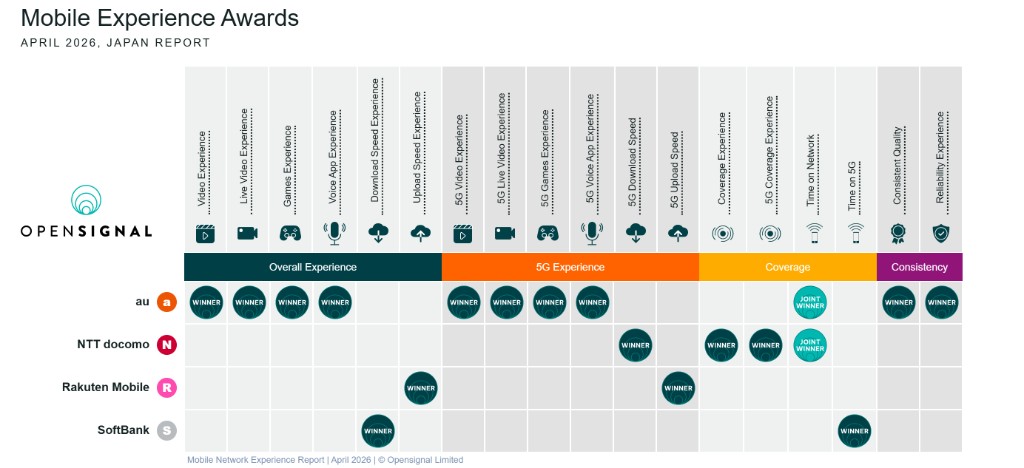
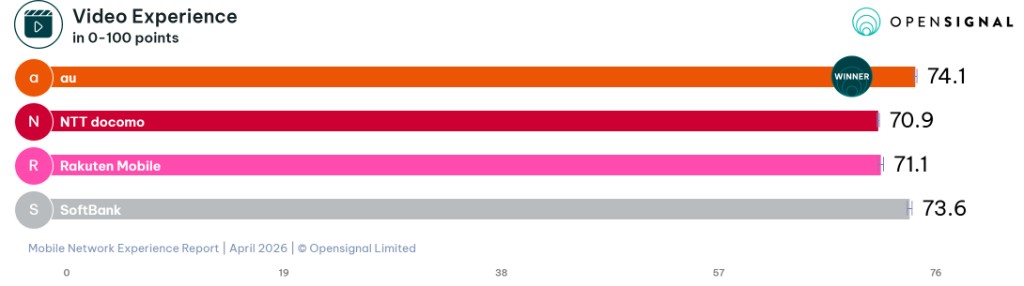
Opensignal’s Coverage Experience scores where people live, work and move. Not empty mountain square kilometres. Sources at the bottom.
1. NTT Docomo: the safety net outside Tokyo
Docomo still wins Coverage Experience (9/10, one point ahead of au (KDDI)) and 5G Coverage Experience (5/10). That is the first test if the JR leaves the Tokaido: Tohoku, Shikoku, inland Kyushu, Hokkaido, onsen towns. 5G download also stays with Docomo (159.1 Mbps, about 9 Mbps ahead of au (KDDI) and SoftBank, a statistical tie between those two).
For a visitor, Docomo means fewer holes between stations. Not the smoothest TikTok in a Shibuya café. eSIMs that name Docomo are the default as soon as the stay is not 100% urban.
PlanJapon is the readable case: Japan only, Docomo stated, hotspot. Useless once you leave the country. Ubigi and Holafly often land on Docomo too. That is not a forever contract. Read the plan page, not a 2024 blog.
2. au (KDDI): the “it just works” city network
au (KDDI) takes the most awards in the April 2026 report: ten solo, one shared, including video, games, voice, consistency and reliability (fourth year running). Fully completed tasks sit at 88.3%, a point ahead of SoftBank.
Tokyo, Kyoto, Osaka, Fukuoka: au (KDDI) is often nicer day to day than the widest network. Maps, WhatsApp, stories. Geographic 5G coverage still trails Docomo. A Kansai weekend with no mountains: au (KDDI). A Hokkaido loop plus a remote onsen: Docomo first.
In our Japan comparison, au (KDDI) is not rare. You see it on Airalo (often paired with SoftBank), BambooSIM, eSIM Card, VoyaSIM, aloSIM, Roamify. The operator line on the SKU you pay for beats the app brand. (SKU here means the exact plan, not the homepage banner.)
3. SoftBank: 5G on the corridor
SoftBank wins average download (about +17% vs the previous report) and time on 5G (27.4%, sole winner). Dense axis, 5G SA in the west, metro, busy shinkansen.
A decent eSIM bet if you stay on postcard Japan. A ferry, a peninsula, a mountain road: the 5G bonus weighs less than Docomo’s footprint. Airalo, Saily and Nomad sell Japan packs. Check the operator on the plan you pay for.
4. Rakuten Mobile: usually the wrong eSIM conversation
Rakuten still leads upload (15.8 Mbps). Handy for sending rushes from Shibuya. For a visitor, two catches.
- The own network is younger. Outside cities, some traffic still rides roaming deals (historically au (KDDI)). A “Rakuten 5G” map is not a “Rakuten mast everywhere” map.
- Wholesale travel eSIMs almost always sit on Docomo, au (KDDI) or SoftBank. An €8 Japan pack is almost never consumer Rakuten.
Only hunt Rakuten on a tourist eSIM if the provider writes it in black and white.
Which brand sticks to which network?
The shopfront is not the mast. Airalo, Holafly, Nomad, Saily, Ubigi resell capacity. PlanJapon owns Docomo. Orange Travel and other Europeans often roam, sometimes onto a different partner than a “local Japan” pack.
| Trip priority | Network to look for | Brands to compare | Promo code |
|---|---|---|---|
| Rural, long JR, Hokkaido, onsen | Docomo | PlanJapon, Ubigi, Holafly, and Japan packs that name Docomo | ESIMC, ESIMP, SIMP |
| Tokyo / Osaka / Kyoto only | au (KDDI) or SoftBank | Airalo, BambooSIM, eSIM Card, Nomad, Saily | ESIMP15, ESIMG, ESIMP, ESIMPNOMAD20, ESIMC |
| Multi-country Asia after Japan | the Japanese partner on the regional pack | compare a Japan plan and an Asia eSIM: the regional can land on a weaker radio | the code for the pack you pay |
The buttons above are affiliate checkout links. The commission does not change Opensignal or the order of the Japan table. A paid slot, if any, is labelled Sponsored.
Three itineraries, three calls
Tokyo + Kyoto + Osaka, 7 days, 10 GB. Almost any serious 4G/5G pack holds. Take one that names Docomo, au (KDDI) or SoftBank, with hotspot if you share to a laptop. au (KDDI) or SoftBank are enough. Docomo does not hurt.
JR Pass + onsen + an island. Docomo first. An unlimited plan whose daily cap is not published in GB is a trap: after the throttle, SoftBank 5G in town will not help in the Japanese Alps.
Japan then Korea or Taiwan. Compare a Japan Docomo pack plus a small local one against an Asia eSIM. Regional wins on simplicity, often loses on radio in Japan. Measurable on both pages, not on a “12 countries” slogan.
How to use eSIM Comparator’s Japan eSIM comparison
- Operator column (Docomo, au (KDDI), SoftBank) before price per GB.
- 5G and hotspot: unlimited without hotspot is a phone plan, not a laptop share.
- Activation: first attach in Japan, or scan the QR at home. Install on Wi-Fi before Narita / Haneda. Turn data roaming on the eSIM only.
- Apply the partner promo, then read the price you pay. Ignore the struck-through shopfront number.
Japan network, by provider
From the catalogue: the operator field on Japan plans. One brand can sit on several networks depending on the plan. Missing rows: packs that do not name the radio. Recheck on the day you buy.


Sources
- Opensignal, Japan Mobile Network Experience April 2026 report. Sample 1 January–31 March 2026. Coverage, 5G, speeds, reliability, consistency.
- ITmedia Mobile, 14 May 2026 Japanese reading of the same report: au (KDDI), 10 awards; Docomo coverage and 5G speed; SoftBank time on 5G.
- NTT Docomo coverage (EN) Official coverage maps, distinct from Opensignal scores.
- au (KDDI) area (EN) au (KDDI) coverage maps.
- MIC, Ministry of Internal Affairs (telecoms) 5G rollout framework and coverage duties. Not an experience ranking.
- Japan eSIM comparison Live plans, operator column, 5G, hotspot. Method: how we compare.
eSIM partners change without notice. This note is dated 26 August 2026. Recheck the operator on the plan page the day you buy.
Some outbound links are affiliate links. A commission does not change rankings, filters or the numbers in the live catalog.