

Quick verdict on eSIMDB
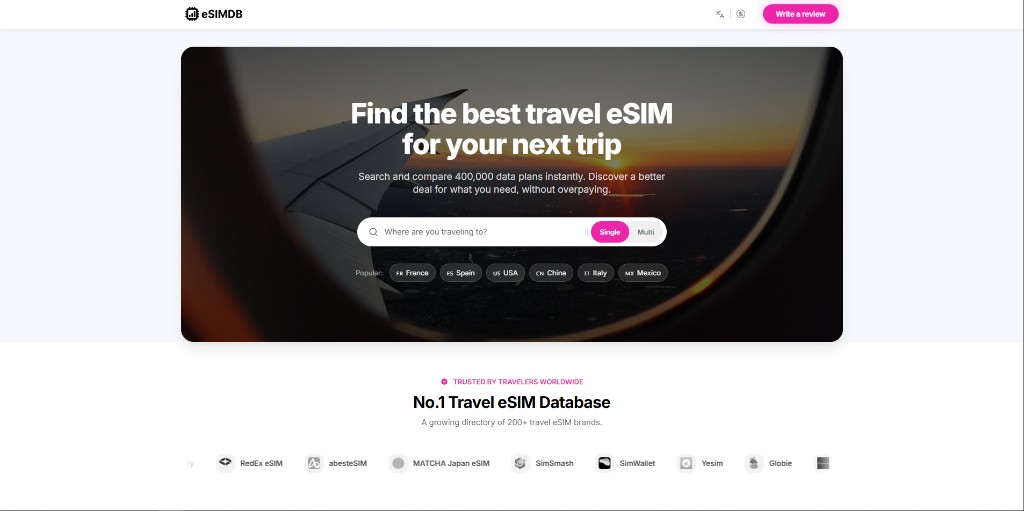
eSIMDB presents itself as an eSIM comparator. On 28 August 2026, the site claims 400,000+ plans and 200+ brands, plus a mobile app. The site is not a shop: like most directories, it sends you to the operator checkout. Affiliation is the model. That is not a flaw. It becomes one if volume, or a promo banner, replaces the explanation.
If you search “eSIMDB review”, the question is not “is it a scam”. It is a discovery tool. The useful question, on 28 August 2026, is: does this list help you pick a plan, or does it make you hesitate longer?
- Useful if you want to dig into little-known brands and rare destinations.
- Two plans with the same GB and the same duration are not interchangeable until the local network, hotspot and fair use are named.
- To compare two offers properly, go to eSIM Comparator: same fields (price, GB, validity, 5G, hotspot), then pay at the operator.
What it is and how it works
Typical path: you enter a destination, eSIMDB shows plans. On 28 August 2026, the site claims 400,000+ plans and 200+ brands, plus a mobile app. The destination pages on eSIM Comparator cover the same need, with a deduplicated catalog.
eSIMDB does not sell the eSIM. Listings, sometimes promo codes, sometimes reviews, are the product. Little public ranking method. Hard to tell why the number 1 card is number 1.
A “5 GB / 7 days” plan is not the same object if it is a named local operator, an MVNO, or a regional pack with fair use. eSIMDB shows offers. It does not always translate between those offers.
Filters and results
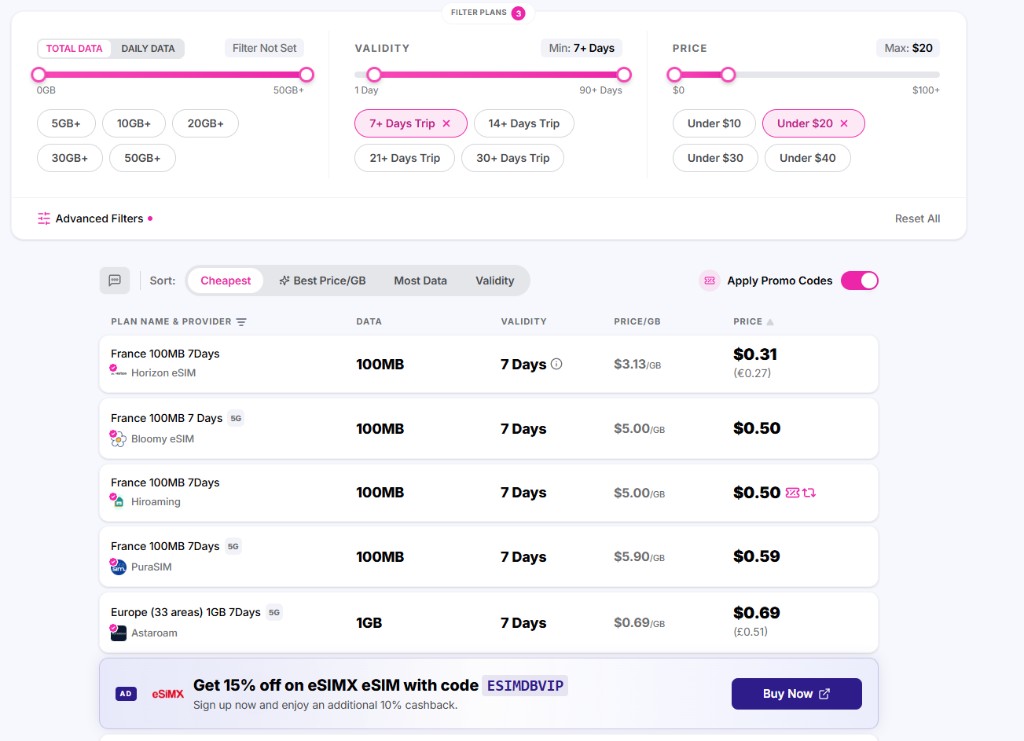
Filters (destination, data, duration, price) make the volume usable. On Spain or the United States, the list still explodes.
Sort by price and you get very cheap entry packs, often short or thin on GB. Sort by data and week-long packs drown under long or unlimited plans with fair use.
A global brand review says nothing about your week in Osaka. Cross-check a country page and, if you can, the local network name.
A promo code only exists if it still works at checkout today, and if the operator is actually listed on that destination. On eSIM Comparator, catalog promo codes are checked every day.
- Filter first by the real length of the trip, not by the cheapest pack.
- Check hotspot and 5G before you judge the price per GB.
- For Europe, open the country list on the pack, not only the word Europe.
- A review with no country and no date weighs little against a network card.
Strengths
- Market coverage: 200+ brands, including names the top 10 comparators skip.
- Plan volume that helps on a rare destination or an odd multi-country combo.
- Filters and sorts you need once the list passes a few dozen cards.
- User reviews: a signal on the app and activation, still to cross-check with the country you visit.
- Promo codes and a mobile app so you can search a plan in the air.
Real weaknesses
- Volume drowns the decision: too many near-identical plans, little visible deduplication.
- Fields are not always comparable across brands (unlimited, fair use, hotspot, named network).
- Little public ranking method.
- A brand-wide review is not a test on your destination.
- Affiliation is the model: read the card, not only the button.
Who eSIMDB is for
Useful if you want to dig into little-known brands and rare destinations.
Less suited to a last-minute weekend. A couple flying Saturday to Lisbon needs three comparable plans, not sixteen thousand rows.
If you already always buy from the same operator (Ubigi, Holafly, Nomad, Saily), eSIMDB is mostly useful to check that no rival offer is ridiculously cheaper. Fine for a scan. Not required as a buying ritual.