In short
For a Japan trip in 2026, buy a Japan eSIM plan if the phone is unlocked and takes an eSIM profile. Install it at home. At Narita, Haneda or Kansai the data is already there: Maps, translation, Suica, JR. Prices and the network column sit on the Japan comparison. Hotel or convenience-store Wi-Fi does not replace a line in the subway.
- Compatible phone. One Japan eSIM. Check the model in the compatibility tool. Docomo if you leave Tokyo.
- Locked phone or no eSIM. Local physical SIM at the airport, or Pocket WiFi rental.
- Tablets, Switch, several screens without eSIM. Pocket WiFi. One eSIM on an adult so you stay reachable without the router.
- EE, O2, Vodafone or Three day pass. Last minute, one afternoon, a forgotten QR. Over a week the Japan eSIM almost always wins.
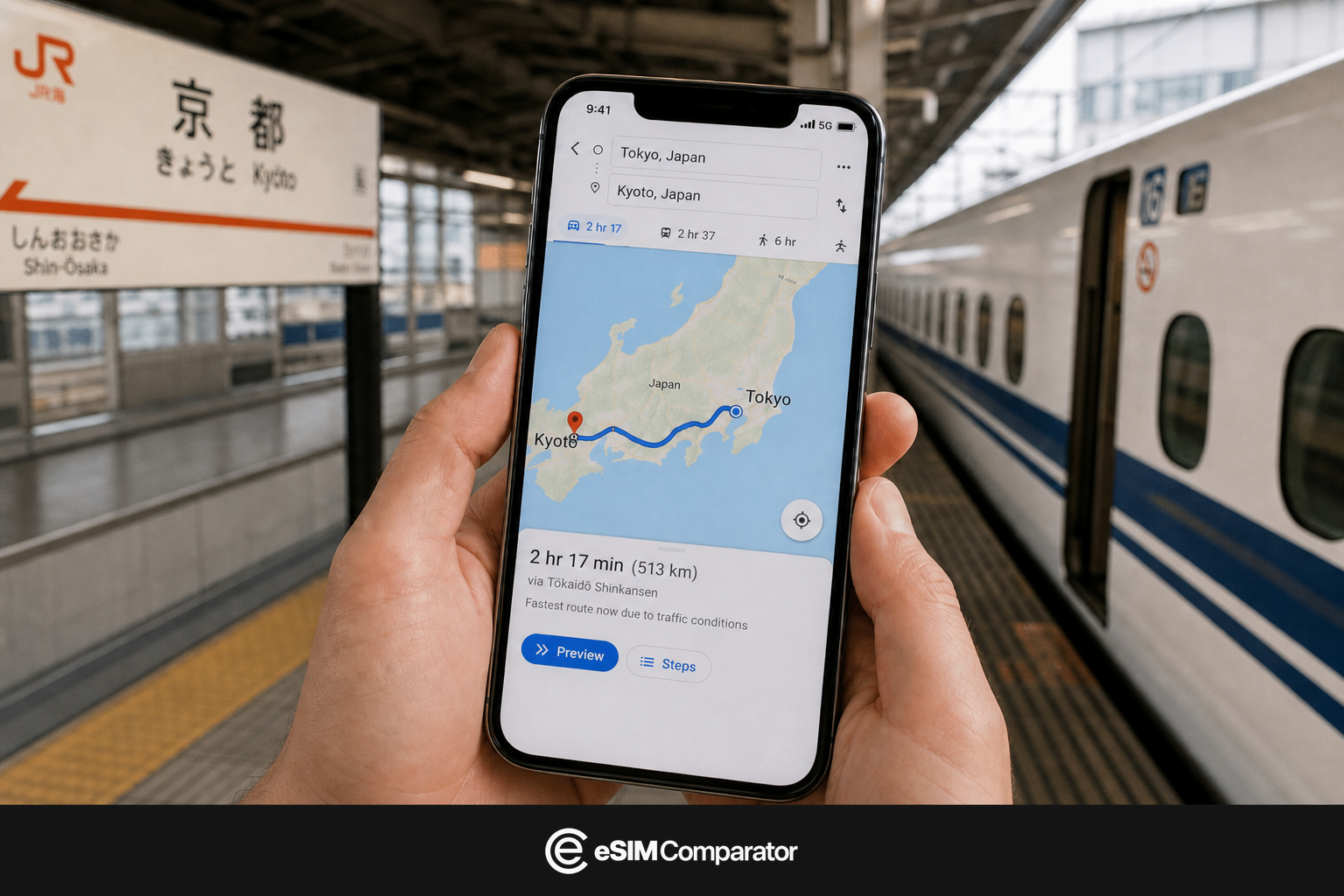
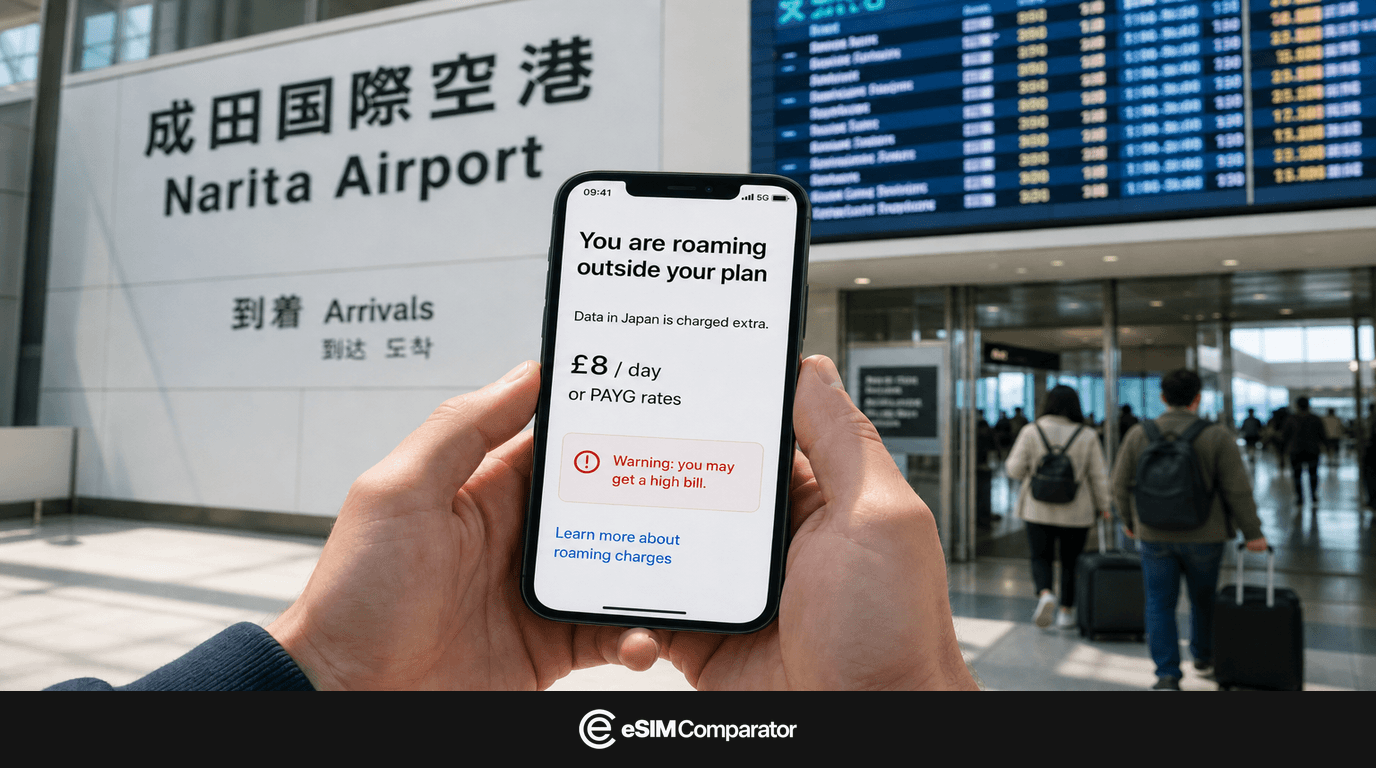
At Narita the arrivals Wi-Fi often wants an email and a captcha. Meanwhile the taxi, Suica and Google Maps wait. An eSIM you scanned at home attaches when you leave airplane mode. That is the move that skips the SIM counter queue and the extra-zone roaming surprise.
Japan travel eSIM: buy it at home if the phone takes one
Unlocked handset that takes an eSIM: buy a Japan plan. No deposit, no locker, nothing to return. The home line stays for bank SMS. Data rides the eSIM.
Install the profile before the flight, on stable Wi-Fi. Read the activation sentence: some plans start at scan, others at first attach in Japan. In the second case, leave the line off until you land.
The radio that matters is Docomo, au (KDDI) or SoftBank, not the app logo. Off the Tokyo-Osaka corridor, prefer a pack that writes Docomo. Network detail lives in best mobile networks in Japan.
PlanJapon names Docomo and hotspot. Airalo, Holafly and Ubigi also sell Japan: open the plan sheet (network, 5G, tethering), not the brand homepage.
The buttons above are affiliate links to checkout. Commission does not change rank or filters. A paid slot, if one exists, is labelled Sponsoring.
EE, O2, Vodafone or Three roaming in Japan
Japan sits outside EU roaming. UK networks do not give you “roam like home” there. Most pay-monthly plans sell a daily pass. Open Maps without one and you either get no data (EE) or you trigger that day’s charge.
UK operators, public pages, August 2026:
| UK operator | Without a Japan pass | What 15 MB of Maps costs | Pass if you stay on the UK SIM |
|---|---|---|---|
| EE | No extra-EU data until you buy a pass (price guide, April 2026) | The day pass, not a per-MB bill | ROW Zone 3 daily pass: £8, 500 MB, unlimited UK-style calls and texts. Japan sits in that zone. No weekly ROW Zone 3 pass on that guide. |
| O2 | Standard roaming unless Travel or Inclusive Zone Ultimate is on the plan | One Travel day if the bolt-on is active | O2 Travel Bolt On: £7/day, Japan listed (75 destinations). Some Ultimate plans include the same list at no extra daily fee. |
| Vodafone | Zone C or D daily fee if Global Roam is not in the plan | One roaming day as soon as data attaches | £8/day on most pay-monthly plans started on or after 11 August 2021. Older plans: often £6/day. Check the roaming checker with your number. |
| Three | Japan is Go Roam Around the World Extra, not Europe | A daily Extra charge, or PAYG if you have no pass (PAYG Extra destinations are a different meter: check Three’s destination tool) | Daily Extra £7 if you joined or upgraded from 1 October 2021. Plans from 18 December 2025: £8/day from 1 April 2026. Complete plans from 22 June 2025 can include Extra. Europe or “Around the World” passes do not cover Japan. |
These are orders of magnitude from August 2026 operator pages. Your join date, extra and fair-use cap change the number. Open My EE, My O2, My Vodafone or the Three app before the flight. Seven days of £7-8 passes is already £49-56. A 7-day eSIM on the Japan comparison is almost always cheaper, and it skips a 500 MB daily cap.
Keep the UK SIM on for calls and bank codes. Turn data roaming off on that line. Point mobile data at the eSIM. If both lines roam, the UK bill comes back.
Roaming wins in three short cases: an improvised afternoon, a work phone that refuses a second profile, a forgotten eSIM at the gate. A Tokyo + Kyoto stay is planned the other way.
Local physical SIM at Narita, Haneda or Kansai
A local plastic SIM still helps if the phone is unlocked but has no eSIM, or if you want a passport counter. BIC Camera, carrier shops and some arrivals kiosks still sell data packs. You wait, you show ID, you swap the card, you sometimes park the home SIM in a sleeve.
Compare the counter price with the Japan eSIM table before you queue. A 5 a.m. arrival often finds the stand shut. An eSIM already on the phone does not care about opening hours.
Same rule as eSIM: read the network (Docomo, SoftBank, au) and hotspot. An “unlimited” SIM whose daily cap is not printed in GB behaves like a throttled plan once you push Maps and translation all day.
Hotel, konbini and shinkansen Wi-Fi in Japan
Japanese Wi-Fi is everywhere on the poster: 7-Eleven, Lawson, FamilyMart, some JR stations, plenty of hotels, sometimes the shinkansen. Japan Wi-Fi auto-connect (NTT BP) registers an account and joins some of those spots. Captive portals work in the hall. They drop in the subway, between platforms, in an onsen with no lounge, on a trail.
Use that Wi-Fi to dump photos to the cloud at night, or to install a forgotten profile. Do not build the trip on it. Suica, Google Maps and offline translation hold better on a cellular line.
Arrivals Wi-Fi at Narita or Haneda is for activating an eSIM if you could not do it at home. Keep the QR offline (screenshot, downloaded mail). A captive portal often kills the scan halfway.
Pocket WiFi in Japan: which gadgets need the router
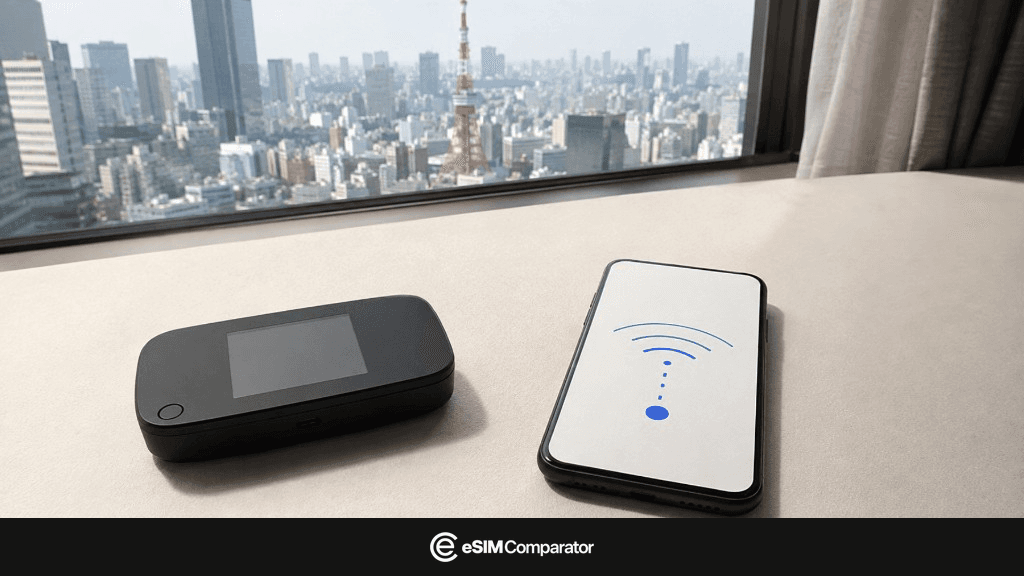
Rent a router only if screens without eSIM remain: teen tablet, Nintendo Switch, old Android, locked phone. A family where every pocket has a recent iPhone buys one eSIM per adult, not a NINJA by default.
eSIM Comparator ranks eSIM plans. It does not list NINJA WiFi, Japan Wireless or Global WiFi. Router versus eSIM, the shops and the 7-day maths live in Japan eSIM vs Pocket WiFi.
How many GB for a stay in Japan
Tokyo, Kyoto, Osaka: you walk with Maps, you shoot photos, you translate menus. The cards match maps + messages + a little video. Add a step if you stream on the shinkansen, or if a laptop stays on hotspot all day.
3-5 days
3-5 GBTokyo city break. Maps, Suica, translation. Hotel Wi-Fi at night.
7-8 days
5-10 GBTokyo then Kyoto. A bit of video on the train. Take 10 GB if you hesitate.
12-15 days
10-15 GBJR Pass, two or three cities. Take 15 days of validity if the flight home is in the morning.
3 weeks
15-20 GBOr unlimited whose daily cap is printed in GB. Recheck hotspot.
The data calculator tightens the step. Then match validity: 7 days for 8 nights is tight. Hokkaido, Japanese Alps, islands: volume matters less than the mast. SoftBank unlimited in town does not fill a Docomo hole you skipped. Pick the network first, then the GB.
Turn data on after landing at Narita or Haneda
- Leave airplane mode.
- Turn the travel eSIM on. Set it as the mobile data line.
- Turn data roaming on that line only. Many iPhones treat a Japan profile as roaming even when it sits on Docomo.
- Turn data roaming off on the home SIM.
- If nothing attaches: airplane mode for thirty seconds, then off. Touch the APN only if the provider listed one.
Failure #1 is roaming left off on the travel line. #2 is a still-locked iPhone (often US or UK) that installs the QR then shows No Service. Check compatibility before you pay.
Solo, couple or family: what internet to pack for Japan
Solo, 8 days, unlocked iPhone, Tokyo then Kyoto. One Japan eSIM, 5 or 10 GB, Docomo if you leave the corridor for a day. No counter. No home-operator “world” pass in parallel.
Couple, two recent Galaxies, JR Pass + an onsen. Two eSIMs. Packs that write Docomo. Hotspot only if a laptop at night, and if the sheet says so.
Family, two adults on eSIM, two tablets. Two phone plans. Pocket WiFi for the tablets if they must stay online on the train. Put the rental quote next to N times the eSIM price.
Locked work phone. Local physical SIM at the airport, Pocket WiFi, or corporate roaming if it is truly included. Do not buy a QR the handset will refuse.
How to find your Japan trip eSIM with our comparison
- Open the Japan page. Network column (Docomo, au (KDDI), SoftBank) before price per GB.
- Filter validity to the real dates, not hotel-night count.
- Tick hotspot if you share to a tablet or laptop.
- Apply the partner promo, then read the price you pay. Ignore the struck-through shop window.
Japan travel internet sources
- Japan eSIM comparison Price, data, hotspot, network column. Method: how we compare.
- Best mobile networks in Japan Docomo, au (KDDI), SoftBank, Rakuten, from Opensignal 2026. Read it once you have picked the connection type.
- Japan eSIM vs Pocket WiFi When to rent a router (NINJA, Japan Wireless, Global WiFi) instead of one eSIM per phone.
- eSIM-compatible phones If the model is missing or “no”, use a local physical SIM or Pocket WiFi.
- NTT Docomo coverage (EN) Official maps, separate from experience scores. Useful off the Tokyo-Osaka corridor.
- EE, pay-monthly price guide (29 April 2026) ROW Zone 3 daily pass: £8, 500 MB. Extra-EU data needs a pass. Recheck which zone Japan sits in on your plan.
- O2 Travel Bolt On £7/day, Japan listed. Inclusive Zone Ultimate uses the same destination list on eligible plans.
- Vodafone UK, global roaming Zone C/D daily fee on many plans from 11 August 2021: £8/day. Use the roaming checker with your number.
- Three, Go Roam Japan is Around the World Extra. Daily Extra £7 or £8 depending on join date. Europe passes do not cover it.
- Japan Wi-Fi auto-connect (NTT BP) Successor app to Japan Connected-free Wi-Fi (ended March 2026). Public spots: a complement, not a cellular line.
eSIM catalogs, roaming passes and counter hours move without notice. This text is dated 28 August 2026. Recheck the network, hotspot and activation sentence on the day you buy.
Some outbound links are affiliate links. A commission does not change rankings, filters or the numbers in the live catalog.